
I’ve run this particular rhythm exercise many times now – I think I first came across it through Search and Reflect with John Stevens.
It starts simple. Ask a group to clap on the first beat of four. Everyone claps together, and it works. There’s a shared pulse, a sense of being “in time.” Even after just a few bars, it feels good — held, connected, steady.
Then you change the task slightly. Same people, same setup, but now the instruction is to clap once every eight beats.
That’s when things change.
There’s no drum or click. Just each person counting internally and trying to hold time on their own.
By the third or fourth cycle, it begins to drift.
Some clap early. Some come in late. A few gradually speed up. Others slow down. The shared timing falls away, even though everyone is still following the same instructions.
The first time I experienced this, it was framed as a kind of failure.
We had been doing fine, and then we lost it.
The message was clear: concentrate more, work harder, “fix your timing”.
At the time, I accepted that. I didn’t think much more about it.
But after years of seeing this pattern — in rooms, on retreats, in my own practice — I began to see it differently.
When Timing Falls Apart
What’s happening in that moment isn’t a lack of skill. It’s the nervous system doing what it does.
Everyone in the group is still keeping time. They’re just not doing it with each other. They’re syncing to their own internal rhythm, and that rhythm is being shaped by all kinds of invisible inputs — breath, attention, stress, tension, fatigue, mood, focus.
This is something we’re rarely taught: we don’t all have the same internal clock. Not even close. And that clock is always shifting.
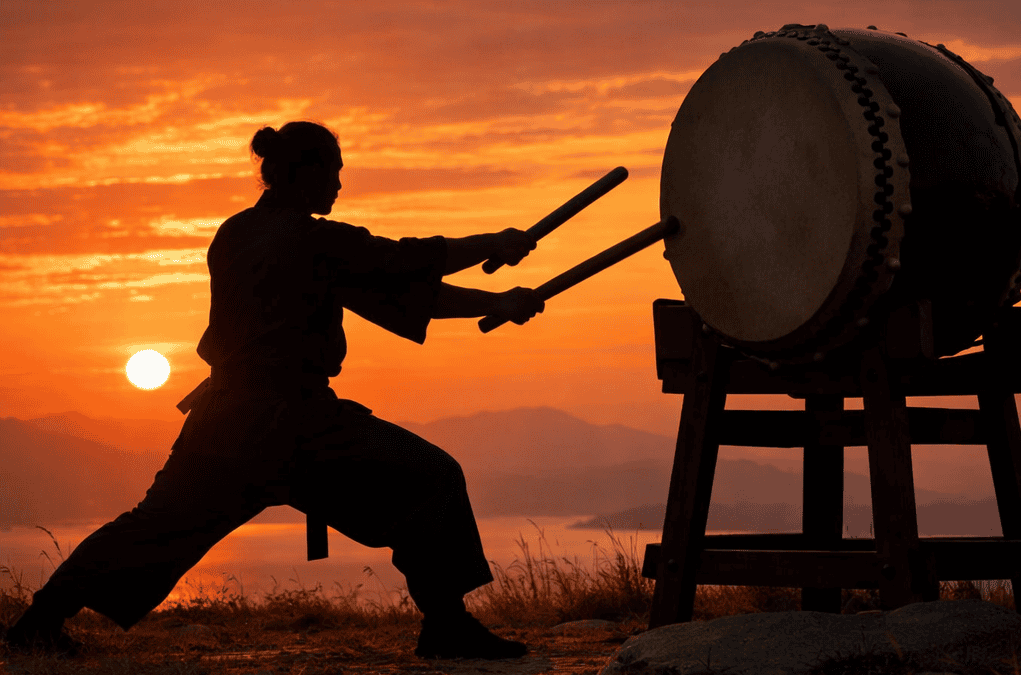
This is where the rhythm warrior appears.
Not the one with perfect technique.
Not the one playing fast or loud.
The rhythm warrior is the one who can feel their own tempo and begin from there.
It isn’t about falling in step with someone else’s rhythm. It’s about recognising your own timing and using it as a guide.
You can still join with others — of course. But when things unravel, when the tempo outside gets too fast or fractured, you know how to return to yourself.
What does that look like in practice?
Say you’re working on some frame drum patterns. You’re aiming for clean, steady quarter notes at a set tempo, but nothing feels right.
Your hands are behind the beat. Your brain feels scrambled. The groove is gone.
The usual instinct is to try harder. Lock in. Push through.
But what if you didn’t?
What if you paused instead, turned off the click, and tapped your own pulse with your foot?
What if you matched your breath to that pulse and gave your system time to settle before picking up the rhythm again?
You might find that once your body’s no longer fighting to catch up, everything lands more naturally.
Less noise. More clarity.
Not because the external tempo changed — but because you returned to your own.
Yes, it echoes the old “feel versus technique” conversation. But this isn’t about choosing one over the other. It’s about understanding where you’re starting from.
The rhythm warrior knows rhythm is lived, not calculated. It’s shaped by state, not just skill. And when you’re attuned to your own timing, you can respond more fluidly — in music, and in life.
What if this isn’t just about practice?
What if holding your own rhythm is something more?
We live in a time where the tempo is being pushed faster and louder every day — by headlines, by algorithms, by fear, by outrage.
The speed of the world has become a pressure system.
And it’s easy to lose your footing in it.
When everyone is reacting, reposting, choosing sides, choosing speed — it’s radical to slow down.
To breathe.
Notice your own pulse.
Don’t match the noise.
This isn’t spiritual escapism. It isn’t neutrality.
It’s attention and presence.
The rhythm warrior doesn’t deny the world.
They stay aware of it, but they don’t let it dictate their tempo.
They feel when things are off-kilter and have a way to come back — to find the deeper rhythm underneath the surface chaos.
Because rhythm isn’t just a technique. It’s a kind of remembering.
And when enough people start remembering together, that has weight.
That has a rhythm of its own.
I write and share rhythm-based practices — some audio, some text — via email.
If that sounds like something you’d like in your week, you can sign up here.